Did you know that the terms “kitty-corner” and “catty-corner” can ignite spirited debates among language lovers? This article dives into the intriguing world of regional language variations, exploring why these terms matter in everyday conversation. Understanding the subtle differences between kitty-corner vs catty-corner not only enriches your vocabulary but also connects you to diverse linguistic traditions. By the end, you’ll be equipped with the knowledge to confidently use these phrases in your daily interactions.
Meaning of Kitty Corner
The terms “kitty-corner” and “catty-corner” both describe something positioned diagonally, but their origins reveal fascinating nuances in linguistic evolution. “Kitty-corner” is often attributed to a playful adaptation of “cater-corner,” which itself stems from the Old French “quater,” meaning to set at a corner.
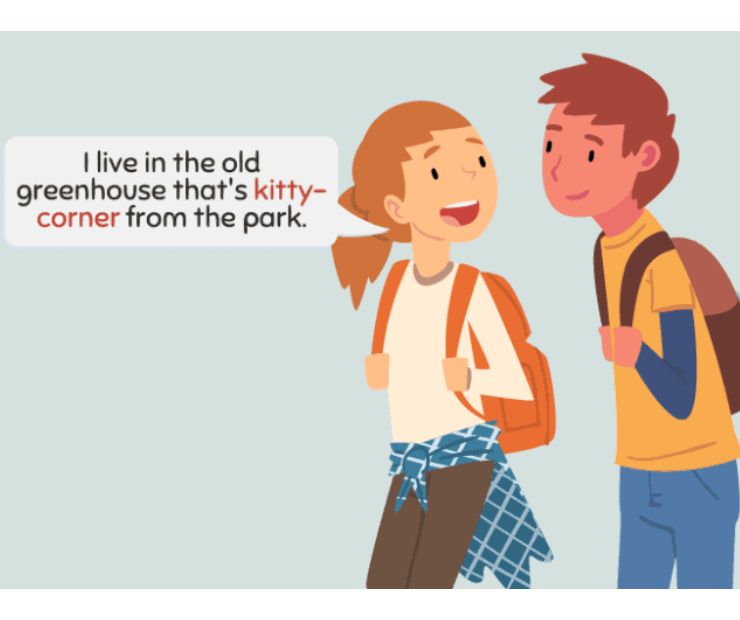
On the other hand, “catty-corner” carries a more robust and somewhat sassy connotation. It suggests not only a physical position but also an attitude perhaps a hint of rivalry or competition. This phrase often evokes images of spirited neighborhoods where homes and personalities are equally vibrant and full of life.
Kitty-Corner or Catty-Corner or Caddy-Corner
The terms “kitty-corner,” “catty corner,” and “caddy corner” weave a charming tapestry of linguistic evolution that reflects the playful nature of language. Originating from the 19th century in America, these words describe a diagonal position and often invoke imagery of cozy neighborhoods where buildings sit playfully askew.
What’s particularly fascinating is how these terms can denote more than just spatial relationships; they embody a sense of community and connection. In a world increasingly marked by digital interactions, the phrase evokes a nostalgic reminder of the days when neighbors conversed over picket fences or engaged in spontaneous gatherings at the corner.
Read more: Fuelled or Fueled: Which One Is The Correct One?
Origin and Etymology Behind Kitty Corner
The term “kitty corner,” commonly used in American English to describe a diagonal position, has an intriguing etymological journey. Rooted in the early 19th century, it appears to derive from the phrase “cater-corner” or “catty-corner,” which itself likely stems from the word “cater,” an old term meaning “to cater” or “to set at a diagonal.” This transformation speaks to the playful evolution of language, where simplicity and ease of pronunciation often take precedence.
Kitty-Corner Synonyms
diagonally
across
obliquely
crosswise
cornerwise
on the diagonal
aslant
on the bias
Kitty-Corner Examples in a Sentence
- The coffee shop is kitty-corner from the library.
- I parked my car kitty-corner to yours in the lot.
- The house was kitty-corner from the elementary school.
- You can find the dentist’s office kitty-corner to the pharmacy.
- The house stood kitty-corner across the square from the bank.
Conclusion
Whether you say caddy-corner, kitty-corner, or catty-corner, the term reflects a regional charm that adds character to our conversations. These expressions not only demonstrate the rich tapestry of language but also highlight how vocabulary can be influenced by culture and geography. Understanding these variations can foster better communication among friends and neighbors, enriching our interactions. So, the next time you’re giving directions or describing a location, feel free to embrace your preferred terminology. Let’s celebrate our linguistic diversity and keep these delightful expressions alive!