Hydrogen powers the sun. Heat drives our weather. Hypotheses spark scientific revolutions. The letter H dominates physical science vocabulary in remarkable ways—starting with hydrogen, the universe’s most abundant element and the first on the periodic table.
From elementary classrooms to quantum physics laboratories, H words form the foundation of how we understand matter, energy, and the physical world. This comprehensive guide explores over 200 physical science terms beginning with H, complete with definitions, real-world applications, and 2026’s latest scientific contexts.
Whether you’re a student mastering science vocabulary, an educator building curriculum, or a science enthusiast expanding your knowledge, you’ll discover essential H terms across physics, chemistry, earth science, and astronomy.
Quick Reference List – Top 20 Physical Science H Words
- Hydrogen – The lightest and most abundant element in the universe (atomic number 1)
- Heat – Energy transferred between systems due to temperature difference
- Hypothesis – A testable prediction or proposed explanation in scientific inquiry
- Hertz – Unit of frequency measurement (cycles per second)
- Helium – Second lightest element, noble gas used in balloons and cooling systems
- Hydrodynamics – Study of fluids in motion and the forces acting on solid bodies in fluids
- Humidity – Amount of water vapor present in air
- Hydrocarbon – Organic compound consisting entirely of hydrogen and carbon
- Homogeneous – Uniform composition throughout a mixture or substance
- Heterogeneous – Non-uniform mixture with visibly different components
- Halogen – Group 17 elements (fluorine, chlorine, bromine, iodine, astatine)
- Heliocentric – Sun-centered model of the solar system
- Hooke’s Law – Principle stating force needed to compress/extend a spring is proportional to distance
- Hurricane – Tropical cyclone with sustained winds exceeding 74 mph
- Hydrology – Scientific study of water movement, distribution, and quality
- Hadron – Composite particle made of quarks held together by strong force
- Harmonics – Integer multiples of a fundamental frequency
- Hysteresis – Dependence of a system’s state on its history
- Hyperbola – Type of conic section formed by intersecting a plane with a double cone
- Hydroxide – Chemical compound containing OH⁻ ion
What Makes H Special in Physical Science?
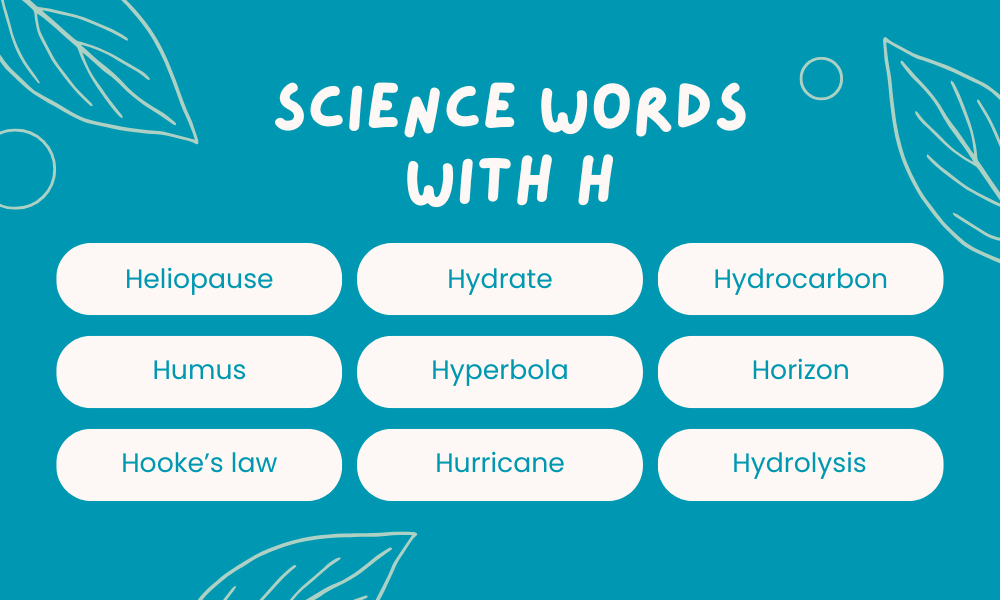
The letter H holds unique significance in physical science vocabulary, primarily because hydrogen—represented by the symbol H—stands as the universe’s foundational element. Formed minutes after the Big Bang, hydrogen comprises approximately 75% of the universe’s normal matter and fuels the nuclear fusion reactions powering every star, including our sun.
Beyond hydrogen itself, H dominates scientific terminology due to historical linguistic roots. Many physical science words beginning with H derive from Greek origins: “hydro” (water), “helios” (sun), “homos” (same), and “heteros” (different). These Greek prefixes created entire families of scientific terms that describe fundamental concepts across multiple disciplines.
The significance of H words extends to foundational scientific principles. Heat and hypothesis represent two of science’s most essential concepts—energy transfer and the scientific method itself. Understanding H vocabulary unlocks comprehension of chemistry’s periodic table, physics equations, earth science processes, and astronomical phenomena.
In 2026, H words remain at the forefront of scientific innovation. Hydrogen fuel cells promise clean energy solutions, hyperspectral imaging advances medical diagnostics, and hydrodynamics simulations improve everything from ship design to blood flow modeling. The vocabulary starting with this eighth letter of the alphabet continues shaping how we explore, explain, and engineer our physical world.
Essential Physical Science H Words for Students
Elementary Level (Grades 3-5)
- Heat – The warmth you feel from the sun, a fire, or hot cocoa. Heat is energy that moves from warmer objects to cooler ones. When you touch a hot stove, heat transfers from the stove to your hand (which is why it hurts!).
- Helium – A super-light gas that makes balloons float and voices sound squeaky. Helium is an element that’s lighter than air, which is why helium balloons rise toward the ceiling. It’s also used to keep MRI machines cold in hospitals.
- Habitat – The natural home where plants or animals live. A fish’s habitat is water, while a cactus’s habitat is the desert. Every living thing needs a habitat with the right temperature, food, and shelter.
- Horizon – The line where the sky appears to meet the earth or ocean. When you watch a sunset, the sun disappears below the horizon. The horizon looks flat, but it’s actually curved because Earth is round.
- Hill – A raised area of land smaller than a mountain. Hills form through various earth science processes including erosion, volcanic activity, and the movement of glaciers over thousands of years.
- Hail – Frozen precipitation that falls as ice balls or irregular lumps. Hail forms when raindrops get carried upward into extremely cold areas of thunderstorm clouds, freezing into ice before falling to the ground.
Middle School Level (Grades 6-8)
- Hydrogen – The simplest and lightest element (atomic number 1) consisting of one proton and one electron. Hydrogen combines with oxygen to create water (H₂O) and serves as fuel for stars through nuclear fusion. In 2026, hydrogen fuel cells are increasingly used in electric vehicles and power generation.
- Hypothesis – A testable prediction or educated guess about how something works in nature. Before conducting experiments, scientists create hypotheses based on observations and research. For example: “If plants need sunlight to grow, then plants kept in darkness will not grow as tall.”
- Humidity – The measurement of water vapor concentration in air, typically expressed as relative humidity percentage. High humidity makes summer days feel stickier because sweat evaporates more slowly. Weather forecasters track humidity to predict precipitation and comfort levels.
- Hydrocarbon – Organic chemical compounds made exclusively of hydrogen and carbon atoms. Methane (CH₄), propane (C₃H₈), and octane (C₈H₁₈) are common hydrocarbons found in natural gas and gasoline. Understanding hydrocarbons is essential for studying energy sources and organic chemistry.
- Hertz (Hz) – The standard unit measuring frequency, defined as one cycle per second. Named after physicist Heinrich Hertz, this unit measures everything from sound waves (human hearing: 20-20,000 Hz) to radio frequencies (FM radio: 88-108 MHz) to processor speeds in computers.
- Homogeneous mixture – A mixture with uniform composition throughout, where individual components cannot be visibly distinguished. Salt water, air, and steel are homogeneous mixtures. The salt dissolves completely in water, creating the same concentration everywhere in the solution.
- Heterogeneous mixture – A mixture with non-uniform composition where different components remain distinguishable. Trail mix, soil, and granite rock are heterogeneous mixtures. You can see and separate the individual nuts, raisins, and chocolate pieces in trail mix.
- Hydroelectric – Relating to electricity generated by flowing or falling water. Hydroelectric dams convert the kinetic energy of moving water into electrical energy. This renewable energy source provides approximately 16% of global electricity production in 2026.
High School Level (Grades 9-12)
- Hydrodynamics – The branch of physics studying liquids in motion and the forces exerted on or by moving fluids. Applications range from designing efficient ship hulls to modeling blood flow through arteries. Engineers use hydrodynamic principles to optimize pipeline systems and predict flood behavior.
- Hyperbola – A type of conic section formed when a plane intersects both nappes of a double cone at an angle steeper than the cone’s side. Mathematically defined as the set of all points where the absolute difference of distances to two fixed points (foci) is constant. Hyperbolas appear in physics when describing object trajectories with excess energy escaping gravitational fields.
- Hysteresis – The phenomenon where a material’s state depends on its history, creating a lag between input and output. Magnetic hysteresis explains why iron retains some magnetization after an external magnetic field is removed. This concept appears in elastic materials, thermodynamics, and biology.
- Hyperfine structure – The small splitting of spectral lines in atomic physics caused by interactions between nuclear magnetic moments and electron magnetic fields. This quantum mechanical effect enables atomic clocks’ incredible precision, achieving accuracy within one second per 15 billion years by 2026.
- Hadron – Composite subatomic particles made of quarks bound by the strong nuclear force. Protons and neutrons are the most common hadrons. The Large Hadron Collider studies these particles to understand fundamental physics, including the Higgs boson discovery.
- Harmonic oscillator – A system experiencing a restoring force proportional to displacement from equilibrium (F = -kx). Springs, pendulums, and molecular vibrations approximate harmonic oscillators. This model is fundamental to quantum mechanics, describing particle behavior at atomic scales.
- Hess’s Law – A principle in thermochemistry stating that total enthalpy change for a reaction equals the sum of enthalpy changes for individual steps. This law allows chemists to calculate heat changes for reactions that cannot be measured directly.
- Hydrostatic pressure – The pressure exerted by a fluid at rest due to gravitational force. Calculated as P = ρgh (density × gravity × height). Submarine designers, dam engineers, and medical professionals studying blood pressure all apply hydrostatic principles.
Physical Science H Words by Subject
Physics Words Starting with H
- Heat – In thermodynamics, heat represents energy transferred between systems due to temperature differences. Unlike temperature (which measures average kinetic energy), heat measures total energy transfer. The first law of thermodynamics treats heat as one form of energy that can be converted to work. Modern applications include heat pumps for efficient building climate control and waste heat recovery systems in industrial processes.
- Hertz (Hz) – The SI unit of frequency measuring cycles per second, named after German physicist Heinrich Hertz who proved electromagnetic wave existence. Applications span the electromagnetic spectrum: AM radio (540-1600 kHz), WiFi (2.4 and 5 GHz), visible light (430-770 THz), and X-rays (30 PHz to 30 EHz). In 2026, 6G wireless networks are being tested at frequencies exceeding 100 GHz.
- Harmonics – Integer multiples of a fundamental frequency that combine to create complex waveforms. When you pluck a guitar string, you hear the fundamental frequency plus harmonics (overtones) at 2f, 3f, 4f, etc. Harmonics determine timbre, allowing you to distinguish a violin from a flute playing the same note. Power engineers also combat problematic harmonics in electrical grids that can damage equipment.
- Hooke’s Law – The principle stating that the force needed to extend or compress a spring is proportional to the displacement distance: F = -kx, where k is the spring constant. This linear relationship holds within the elastic limit. Applications include shock absorbers, weighing scales, and seismographs. Material scientists use Hooke’s Law to measure elasticity in everything from rubber bands to building materials.
- Hadron – Composite particles made of quarks held together by the strong nuclear force (quantum chromodynamics). Baryons (three quarks) include protons and neutrons, while mesons contain quark-antiquark pairs. The Large Hadron Collider at CERN continues discovering new hadron configurations in 2026, expanding our understanding of matter’s fundamental structure.
- Half-life – The time required for half of a radioactive substance to decay. Carbon-14 has a half-life of 5,730 years (used in archaeological dating), while uranium-238’s half-life is 4.5 billion years. Medical imaging uses short half-life isotopes like technetium-99m (6 hours) to minimize radiation exposure while providing diagnostic information.
- Helmholtz coils – A pair of identical circular coils arranged parallel to each other, separated by a distance equal to their radius, creating a uniform magnetic field in the region between them. Physics laboratories use Helmholtz coils to cancel Earth’s magnetic field or create controlled magnetic environments for experiments.
- Hydraulic – Relating to fluid mechanics where confined liquids transmit force. Pascal’s principle explains hydraulic systems: pressure applied to a confined fluid transmits equally throughout the fluid. Car brakes, excavators, and aircraft control surfaces use hydraulic systems because liquids are incompressible, providing reliable force transmission.
- Hypersonic – Describing speeds exceeding Mach 5 (five times the speed of sound, approximately 3,836 mph at sea level). Hypersonic flight creates unique physics challenges including extreme heating, shock wave interactions, and plasma formation around vehicles. In 2026, several nations are testing hypersonic weapons and spacecraft reentry systems.
Chemistry Terms Beginning with H
- Hydrogen – The first element on the periodic table (atomic number 1), consisting of one proton and one electron in its most common isotope. Hydrogen is the universe’s most abundant element and the primary fuel for stellar fusion. On Earth, hydrogen rarely exists in pure form, instead bonding with oxygen (water), carbon (hydrocarbons), and nitrogen (ammonia). Green hydrogen production through water electrolysis using renewable energy represents a major 2026 clean energy initiative.
- Halogen – The group 17 elements including fluorine, chlorine, bromine, iodine, and astatine. These highly reactive nonmetals readily form salts with metals (hence “halogen” from Greek “salt-former”). Halogens have seven valence electrons and need one more to complete their outer shell. Chlorine disinfects water, iodine is essential for thyroid function, and fluorine strengthens tooth enamel in toothpaste.
- Hydroxide – A chemical compound containing the hydroxide ion (OH⁻), formed by oxygen and hydrogen atoms sharing electrons. Sodium hydroxide (NaOH) and potassium hydroxide (KOH) are strong bases used in soap making and industrial processes. Hydroxide ions increase solution pH, neutralize acids, and participate in countless biological reactions.
- Hydrocarbon – Organic compounds consisting exclusively of hydrogen and carbon atoms. Alkanes (single bonds), alkenes (double bonds), and alkynes (triple bonds) form the major hydrocarbon families. Methane (CH₄) is the simplest hydrocarbon and primary component of natural gas. Petroleum contains thousands of different hydrocarbons that are separated through fractional distillation.
- Hydrate – A compound containing water molecules incorporated into its crystal structure. Copper(II) sulfate pentahydrate (CuSO₄·5H₂O) appears blue due to water molecules, but turns white when heated and water is driven off. Gas hydrates, also called clathrates, trap methane molecules in ice crystals on ocean floors, representing both a potential energy source and climate concern.
- Hydrolysis – A chemical reaction where water breaks chemical bonds, splitting molecules into smaller components. The word combines “hydro” (water) and “lysis” (breaking). Hydrolysis reactions digest food (breaking proteins into amino acids), and weathering rocks (feldspar converting to clay). Ester hydrolysis produces carboxylic acids and alcohols.
- Hydrogen bond – A weak intermolecular attraction between a hydrogen atom bonded to highly electronegative atoms (N, O, or F) and another electronegative atom. Hydrogen bonds give water its unique properties: high boiling point, surface tension, and expansion when frozen. DNA’s double helix structure relies on hydrogen bonds between base pairs.
- Homogeneous catalyst – A catalyst existing in the same phase as reactants, typically dissolved in solution. Homogeneous catalysts provide excellent contact with reactants, enabling reactions at lower temperatures. Industrial examples include acid catalysis in esterification reactions and organometallic complexes in pharmaceutical synthesis.
- Heterogeneous catalyst – A catalyst in a different phase from reactants, typically solid catalysts with gas or liquid reactants. Catalytic converters in vehicles use platinum, palladium, and rhodium to convert toxic gases into less harmful emissions. Haber process uses iron catalysts to synthesize ammonia from nitrogen and hydrogen.
- Haloalkane – Organic compounds where one or more hydrogen atoms in an alkane are replaced by halogen atoms. Also called alkyl halides, these compounds serve as important synthetic intermediates. Chlorofluorocarbons (CFCs), now banned due to ozone depletion, were historically used as refrigerants.
Earth Science H Vocabulary

- Hydrology – The scientific study of water’s movement, distribution, and quality across Earth’s hydrologic cycle. Hydrologists investigate precipitation patterns, groundwater flow, river discharge, and watershed management. In 2026, advanced hydrology modeling helps predict flood risks, manage water resources amid climate change, and assess drought impacts on agriculture.
- Hydrosphere – All water found on, under, and above Earth’s surface, including oceans, lakes, rivers, groundwater, ice caps, and atmospheric water vapor. The hydrosphere contains approximately 1.386 billion cubic kilometers of water, with 97% in oceans. This sphere constantly interacts with the atmosphere, geosphere, and biosphere through the water cycle.
- Hurricane – A tropical cyclone with maximum sustained winds exceeding 74 mph (119 km/h), featuring a defined eye, eyewall, and spiral rain bands. Hurricanes derive energy from warm ocean water (typically above 80°F/27°C) and require low wind shear to develop. The 2026 Atlantic hurricane season continues showing increased intensity patterns linked to warming ocean temperatures.
- Humidity – The amount of water vapor present in air, commonly expressed as relative humidity (percentage of maximum moisture air can hold at a given temperature). Absolute humidity measures actual water vapor mass per air volume, while specific humidity compares water vapor mass to total air mass. Meteorologists track humidity to forecast precipitation, frost, and fog.
- Humus – Dark, organic material in soil resulting from decomposed plant and animal matter. Humus improves soil structure, water retention, and nutrient availability. Unlike fresh organic matter, humus is chemically stable and can persist in soil for decades. Healthy agricultural soils typically contain 1-6% organic matter, mostly as humus.
- Hydroelectric – Electricity generation using gravitational potential energy from elevated water. Dams create reservoirs that release water through turbines, converting kinetic energy to electrical energy. Run-of-river systems generate power without large reservoirs. Pumped-storage hydroelectricity serves as energy storage, pumping water uphill during low demand and releasing it during peak demand.
- Headwater – The source or upper tributaries of a river, typically in elevated terrain. Headwater streams are small, cool, and oxygen-rich, supporting specialized ecosystems. Protecting headwaters maintains water quality throughout entire watersheds since pollution introduced upstream affects all downstream areas.
- Hygrometer – An instrument measuring atmospheric humidity. Psychrometers use two thermometers (one dry, one wet) to calculate relative humidity. Electronic hygrometers employ capacitive or resistive sensors that change electrical properties with moisture exposure. Accurate humidity measurement is essential for weather forecasting, agriculture, and industrial processes.
- Hydrothermal vent – Fissures on the ocean floor releasing geothermally heated water, often exceeding 700°F (370°C). These vents occur near tectonic plate boundaries and volcanic hotspots. Unique ecosystems thrive around vents, including tube worms and bacteria that chemosynthesis instead of photosynthesis, fundamentally changing our understanding of where life can exist.
- Hematite – An iron oxide mineral (Fe₂O₃) appearing reddish-brown and serving as the primary iron ore. Hematite forms in sedimentary, metamorphic, and igneous environments. Ancient hematite deposits provide evidence of oxygen in Earth’s early atmosphere. Ground hematite creates red ochre pigment used in prehistoric cave paintings.
Astronomy & Space Science
- Heliocentric – The model placing the sun at the solar system’s center, with planets orbiting around it. Nicolaus Copernicus proposed this revolutionary concept in 1543, contradicting the geocentric (Earth-centered) model. Galileo’s telescopic observations of Venus’s phases and Jupiter’s moons provided crucial evidence supporting the heliocentric model.
- Heliopause – The boundary where the sun’s solar wind meets interstellar space, approximately 120 astronomical units (11 billion miles) from the sun. Voyager 1 crossed the heliopause in 2012, becoming the first human-made object entering interstellar space. The heliopause shape is asymmetric, forming a “nose” in the direction of solar system motion through the galaxy.
- Hypernova – An extremely energetic supernova, releasing at least 100 times more energy than typical supernovae. Hypernovae likely result from massive stars (over 30 solar masses) collapsing into black holes. These explosions produce gamma-ray bursts, the universe’s brightest electromagnetic events. Heavy elements beyond iron are forged in hypernova explosions.
- Helioseismology – The study of the sun’s interior structure by analyzing oscillations and waves on its surface. Like seismology studies Earth’s interior through earthquakes, helioseismology uses sound waves bouncing through the sun. This technique revealed the sun’s differential rotation (equator rotates faster than poles) and internal temperature distribution.
- Hubble’s Law – The observation that galaxies recede from us at velocities proportional to their distances, expressed as v = H₀d (velocity equals Hubble constant times distance). Edwin Hubble’s 1929 discovery provided the first evidence for universal expansion. In 2026, the Hubble constant value remains debated, with different measurement methods yielding slightly different results (the “Hubble tension”).
- H-R Diagram (Hertzsprung-Russell) – A graph plotting stars’ luminosity versus temperature (or absolute magnitude versus spectral class). This fundamental astronomy tool reveals stellar evolution patterns. Main sequence stars form a diagonal band where most stars (including our sun) spend the majority of their lives. Giants, supergiants, and white dwarfs occupy distinct regions.
- Hydrostatic equilibrium – The balance between gravitational collapse and internal pressure in stars and planets. For stars, thermal pressure from nuclear fusion counteracts gravity. When fusion ceases, gravity wins, causing stellar collapse into white dwarfs, neutron stars, or black holes depending on mass.
- Habitable zone – The region around a star where planetary surface conditions could support liquid water. Also called the “Goldilocks zone,” it’s neither too hot (water evaporates) nor too cold (water freezes). Star temperature determines habitable zone distance. In 2026, the James Webb Space Telescope analyzes atmospheres of exoplanets within habitable zones, searching for biosignature gases.
- Heliosphere – The vast bubble of space dominated by the sun’s solar wind and magnetic field, extending far beyond Pluto. The solar wind (charged particles streaming from the sun) creates this protective bubble deflecting some galactic cosmic rays. The heliosphere’s boundary is the heliopause.
- H II region – A cloud of ionized hydrogen gas in interstellar space, appearing as emission nebulae. Hot, young stars emit ultraviolet radiation that ionizes surrounding hydrogen. The famous Orion Nebula is an H II region visible to the naked eye. These regions mark active star formation sites.
Cool Examples of H Words in Action
Hydrogen – The Universe’s Building Block
Hydrogen’s story begins 380,000 years after the Big Bang when the universe cooled enough for protons and electrons to combine, forming neutral hydrogen atoms. This “recombination” allowed light to travel freely for the first time, creating the cosmic microwave background radiation we detect today.
In stars: Nuclear fusion in stellar cores combines four hydrogen nuclei into one helium nucleus through the proton-proton chain reaction. This process releases tremendous energy (E=mc²), powering stars for billions of years. Our sun fuses 600 million tons of hydrogen into helium every second, converting 4 million tons of matter into pure energy.
In water formation: Perhaps hydrogen’s most important terrestrial role is forming water (H₂O). The Big Bang created hydrogen, while oxygen formed inside dying stars and scattered through supernova explosions. When hydrogen and oxygen combine through combustion (2H₂ + O₂ → 2H₂O), they release energy while forming the molecule essential for life.
In 2026 clean energy: Hydrogen fuel cells generate electricity through an electrochemical reaction combining hydrogen and oxygen, producing only water as a byproduct. Toyota’s Mirai, Hyundai’s NEXO, and emerging truck manufacturers use hydrogen fuel cells. Green hydrogen, produced by splitting water using renewable electricity, offers carbon-free energy storage. Major 2026 projects include hydrogen-powered ferries in Norway, steel production in Sweden using hydrogen instead of coal, and hydrogen trains operating in Germany.
In chemistry and industry: Hydrogen is essential for producing ammonia (Haber-Bosch process), which creates fertilizers feeding billions. Hydrogenation converts liquid vegetable oils into solid fats for margarine and processed foods. Petroleum refineries use hydrogen to remove sulfur impurities and crack heavy hydrocarbons into lighter, more valuable products like gasoline.
Heat Transfer in Everyday Life
Cooking examples: When you boil water, heat transfers from the stove burner through conduction (direct contact with the pot), then through convection as hot water rises and cooler water descends, creating circulation currents. Microwave ovens use a completely different mechanism—electromagnetic radiation (heat transfer by radiation) causes water molecules to vibrate, generating heat from within the food itself.
Grilling demonstrates all three heat transfer modes simultaneously: conduction from hot grill grates creating sear marks, convection from hot air surrounding the food, and thermal radiation from glowing coals or gas flames. Understanding heat transfer explains why metal cookware heats faster than ceramic (higher thermal conductivity) and why food cooks more evenly at lower temperatures (time for heat to conduct into the center).
Weather systems: Earth’s weather engine runs on heat transfer. Solar radiation heats Earth’s surface unevenly—equatorial regions receive more direct sunlight than poles. This temperature difference drives atmospheric convection: warm air rises at the equator, travels toward poles at high altitude, cools and sinks, then returns toward the equator at surface level (Hadley cells).
Ocean currents transport massive amounts of heat. The Gulf Stream carries warm water from the Caribbean to Northern Europe, making British winters much milder than similar latitudes in Canada. El Niño and La Niña patterns result from changes in Pacific Ocean heat distribution, affecting global weather for months.
Technology applications: Computer processors generate intense heat in tiny spaces. Heat sinks use high thermal conductivity metals (copper or aluminum) to conduct heat away from chips. Fans force convection, moving hot air away and bringing cooler air in. Advanced gaming computers and data centers use liquid cooling systems, pumping coolant through tubes attached to components.
Building HVAC systems leverage heat transfer principles for efficiency. Heat pumps exploit the physics fact that compressed gases heat up while expanding gases cool down. In winter, heat pumps extract heat from outdoor air (even at 32°F air contains thermal energy), compress the refrigerant to concentrate that heat, and release it indoors. They reverse this process for summer cooling, making them 300% efficient—moving three joules of heat for every joule of electricity consumed.
Thermos bottles minimize heat transfer through vacuum insulation (eliminating conduction and convection in the gap between walls), reflective coating (reducing radiative heat transfer), and insulating cap. This triple-barrier approach keeps hot drinks hot and cold drinks cold for hours.
Hypothesis in Modern Science
A hypothesis transforms vague curiosity into testable predictions, forming the foundation of the scientific method. Good hypotheses are specific, measurable, and falsifiable—they can be proven wrong through experimentation.
Recent scientific breakthroughs: The Higgs boson hypothesis, proposed in 1964, predicted a field permeating space that gives particles mass. This remained unproven until 2012 when CERN’s Large Hadron Collider detected the Higgs particle, confirming the hypothesis after 48 years. Peter Higgs received the Nobel Prize in 2013.
COVID-19 vaccine development demonstrated hypothesis-driven science operating at unprecedented speed. Scientists hypothesized that mRNA encoding the spike protein would trigger immune responses without causing disease. Within months, clinical trials tested this hypothesis, leading to vaccines that saved millions of lives. The 2026 medical landscape continues leveraging this platform for cancer vaccines and other treatments.
Gravitational wave detection validated Einstein’s 1916 hypothesis that accelerating masses create ripples in spacetime. LIGO’s 2015 detection of waves from merging black holes confirmed this century-old prediction, opening an entirely new way to observe the universe. In 2026, gravitational wave astronomy continues revealing cosmic events invisible to electromagnetic telescopes.
How to write a good hypothesis: Start with observation: “I notice plants in my room facing the window lean toward sunlight.” Research the topic: “Plants contain photoreceptors that detect light direction.” Formulate your testable prediction: “If plants detect and grow toward light sources, then a plant surrounded by mirrors reflecting light from all directions will grow straighter than a control plant with light from only one direction.”
Characteristics of strong hypotheses:
- Uses “if…then” structure showing cause and effect
- Identifies independent variable (what you change) and dependent variable (what you measure)
- Specific enough to test with available resources
- Based on research and logical reasoning, not random guessing
- Can be proven false if the prediction doesn’t match results
Famous hypotheses that changed science: Dmitri Mendeleev hypothesized that elements with similar properties repeat periodically when arranged by atomic weight, creating the periodic table in 1869. His hypothesis was so robust he left gaps for undiscovered elements and predicted their properties. Gallium, scandium, and germanium were later discovered exactly where he predicted with the properties he described.
Louis Pasteur hypothesized that microorganisms caused fermentation and disease, contradicting spontaneous generation theory. His swan-neck flask experiment proved that bacteria came from the environment, not spontaneous creation, revolutionizing medicine and food preservation.
Hydrodynamics in Engineering
Hydrodynamics—the study of fluids in motion—shapes our modern world from ship design to cardiovascular medicine.
Ship design: Naval architects use hydrodynamic principles to minimize drag and maximize efficiency. A ship’s hull must displace water equal to the ship’s weight (Archimedes’ principle) while minimizing resistance. Bulbous bows—the bulge protruding from the hull below the waterline—seem counterintuitive but actually reduce drag by modifying water flow patterns around the hull. This hydrodynamic innovation saves massive amounts of fuel on large vessels.
Hydrofoils lift boat hulls above water at high speeds, reducing drag dramatically. As speed increases, underwater wings generate lift (similar to aircraft wings in air), raising the hull clear of the water. With only the foils and struts touching water, resistance decreases significantly. In 2026, electric hydrofoil ferries operate in dozens of cities, offering fast, efficient, nearly silent water transportation.
Pipeline systems: Oil, gas, and water flow through millions of miles of pipelines globally. Engineers apply the Bernoulli equation (relating pressure, velocity, and elevation in flowing fluids) to design efficient systems. Pipe diameter affects flow rate and pressure—narrower pipes increase velocity but also increase friction losses. Pump stations along pipelines maintain pressure to overcome friction and elevation changes.
The Reynolds number (Re = ρvD/μ) predicts whether flow will be laminar (smooth, ordered) or turbulent (chaotic, mixing). Low Reynolds numbers indicate laminar flow where viscous forces dominate. High Reynolds numbers mean turbulent flow where inertial forces dominate. Pipeline operators optimize flow regimes to minimize energy consumption while maintaining required throughput.
2026 innovations: Computational fluid dynamics (CFD) simulations model complex hydrodynamic scenarios impossible to test physically. Boeing and Airbus design aircraft using CFD to optimize aerodynamics (a subset of fluid dynamics treating air as a fluid). Formula 1 teams run thousands of CFD simulations to shave milliseconds from lap times through improved airflow.
Biomimetic hydrodynamics studies how aquatic animals move efficiently through water, then applies these principles to technology. Shark skin’s dermal denticles reduce drag—swimsuit manufacturers and ship coating companies replicate this texture. Whale fin tubercles (bumpy protrusions on humpback fins) improve lift and reduce drag at high angles of attack, inspiring wind turbine blade designs.
Microfluidics manipulates tiny fluid volumes (microliters to picoliters) in channels smaller than human hairs. Lab-on-a-chip devices perform medical diagnostics from single blood drops. In 2026, microfluidic devices enable rapid COVID variant detection, cancer screening, and personalized medicine dosing—all leveraging hydrodynamic principles at microscopic scales.
Blood flow modeling helps cardiovascular surgeons predict surgical outcomes. Patient-specific CFD simulations, built from CT scans, show how blood will flow through proposed bypass grafts or stent placements before surgery. This hydrodynamic analysis improves success rates and reduces complications.
Advanced Physical Science H Terms

Hyperspectral imaging – Remote sensing technology capturing images across hundreds of narrow, contiguous wavelength bands from ultraviolet through near-infrared. Unlike RGB cameras capturing three color bands or multispectral cameras capturing 5-10 bands, hyperspectral sensors record 100-200+ bands. Each pixel contains a complete spectrum enabling material identification based on spectral signatures.
Applications span multiple fields. In agriculture, hyperspectral imaging detects plant stress, nutrient deficiencies, and diseases before visible to the human eye. Different chlorophyll concentrations, water content, and biochemical changes create distinctive spectral patterns. Farmers use drone-mounted hyperspectral cameras for precision agriculture, applying fertilizers and pesticides only where needed.
Medical diagnostics benefit from hyperspectral imaging’s ability to distinguish healthy tissue from diseased tissue. Cancerous cells have different metabolic and oxygenation characteristics that alter their spectral signatures. Surgeons use hyperspectral cameras during operations to identify tumor boundaries, improving complete removal while preserving healthy tissue. In 2026, handheld hyperspectral devices assist dermatologists in melanoma detection.
Environmental monitoring uses hyperspectral satellites to track ocean health, forest composition, mineral deposits, and pollution. Scientists identify algal bloom species from space, monitor coral reef bleaching, and map invasive plant species—all by analyzing spectral signatures invisible to conventional cameras.
Heisenberg Uncertainty Principle – A fundamental limit in quantum mechanics stating that certain pairs of physical properties cannot be simultaneously known with perfect precision. The most famous formulation involves position (x) and momentum (p): Δx·Δp ≥ ℏ/2, where ℏ is the reduced Planck constant.
This principle isn’t about measurement limitations or instrument precision—it’s intrinsic to nature. Particles don’t have exact positions and momenta simultaneously. The act of measuring one property fundamentally disturbs the other. Precisely measuring an electron’s position requires short-wavelength photons (high energy) that significantly alter the electron’s momentum.
The uncertainty principle explains atomic stability. If electrons could have zero momentum, they’d fall into the nucleus. Confinement to small nuclear distances forces significant momentum uncertainty, keeping electrons in orbital shells. This quantum mechanical reality prevents atomic collapse.
Similar uncertainty relationships exist for energy and time (ΔE·Δt ≥ ℏ/2), explaining how particles can “borrow” energy from vacuum for brief moments, creating virtual particle pairs that pop into and out of existence. This effect, confirmed through the Casimir effect, shows the quantum vacuum isn’t truly empty.
Higgs Boson – The elementary particle associated with the Higgs field, discovered at CERN in 2012. The Higgs field permeates all space, and fundamental particles acquire mass through interactions with this field. Particles that interact strongly with the Higgs field (like top quarks) have large masses, while particles that barely interact (like electrons) have small masses. Photons don’t interact with the Higgs field at all, remaining massless.
The Higgs mechanism explains why W and Z bosons (mediating weak nuclear force) have mass while photons (mediating electromagnetic force) don’t. This mass difference is crucial—it’s why weak force has short range (limited by massive force carriers) while electromagnetic force has infinite range (massless photon carriers).
Detecting the Higgs required enormous energy. The Large Hadron Collider accelerates protons to 99.9999991% light speed, smashing them together with energies reaching 13 TeV. These collisions occasionally produce Higgs bosons that immediately decay into other particles. Analyzing billions of collisions revealed the Higgs signal—a small excess of events at 125 GeV/c².
The discovery completed the Standard Model of particle physics but raised new questions. Why does the Higgs have its particular mass? Are there multiple Higgs bosons? Does the Higgs interact with dark matter? In 2026, the High-Luminosity LHC upgrade provides unprecedented collision rates to explore these mysteries.
Hawking radiation – Theoretical thermal radiation predicted to be emitted by black holes due to quantum effects near the event horizon. Stephen Hawking’s 1974 calculations showed that black holes aren’t completely black—they emit radiation and gradually lose mass.
The mechanism involves quantum fluctuations creating virtual particle-antiparticle pairs near the event horizon. Normally, these pairs annihilate almost immediately. However, if one particle falls into the black hole while its partner escapes, the escaping particle becomes real radiation. From an external perspective, the black hole emitted a particle.
This radiation is extraordinarily faint for stellar-mass and supermassive black holes. A black hole with the sun’s mass would have a Hawking temperature of 60 nanokelvins—far colder than the cosmic microwave background. Only micro black holes (if they exist) would have significant Hawking radiation, potentially evaporating completely in bursts of energy.
Hawking radiation creates a profound paradox: what happens to information about matter that fell into a black hole? Quantum mechanics requires information conservation, but Hawking radiation appears thermal (random), destroying information. This “black hole information paradox” remains one of theoretical physics’ deepest problems, suggesting our understanding of quantum gravity is incomplete.
Hadamard transform – A mathematical operation using orthogonal matrices to transform data, closely related to Fourier transforms but requiring only addition and subtraction operations. This computational simplicity makes Hadamard transforms ideal for signal processing in resource-constrained environments.
Applications include image compression (JPEG uses related discrete cosine transforms), cryptography, quantum computing gates, and error correction in digital communications. The Hadamard matrix’s special properties enable efficient multiplexing in spectroscopy—multiple wavelengths can be measured simultaneously, then mathematically separated, dramatically improving signal-to-noise ratios.
Hamiltonian mechanics – A reformulation of classical mechanics using energy rather than forces as the fundamental quantity. The Hamiltonian function H typically represents total energy (kinetic plus potential). Hamilton’s equations of motion describe how position and momentum evolve over time.
This framework proves especially powerful in quantum mechanics. The Schrödinger equation, fundamental to quantum theory, uses the Hamiltonian operator. Phase space diagrams plotting position versus momentum reveal system behavior—periodic orbits indicate stable motion while chaotic trajectories show sensitive dependence on initial conditions.
Rare and Unique H Words in Physical Science
Haversian system – The fundamental functional unit of compact bone tissue, also called an osteon. Each Haversian system consists of concentric layers of calcified matrix (lamellae) surrounding a central Haversian canal containing blood vessels and nerves. Bone cells (osteocytes) reside in small spaces (lacunae) between lamellae, connected by tiny channels (canaliculi) allowing nutrient exchange.
This ingenious structure provides bone’s remarkable combination of strength and relative lightness. The concentric arrangement distributes stress efficiently, similar to tree rings or structural columns. Haversian canals run parallel to bone’s long axis, interconnected by perpendicular Volkmann’s canals, creating a vascular network supplying the entire bone.
The Haversian system demonstrates how biological structures optimize materials engineering principles. Bone constantly remodels itself—osteoclast cells remove old or damaged bone while osteoblasts deposit new bone. This dynamic process repairs microfractures, adapts bone density to mechanical stress (astronauts lose bone density in microgravity), and releases calcium to maintain blood calcium levels.
Heliopause – Previously discussed in astronomy, but worth deeper exploration as the boundary where solar wind pressure equals interstellar medium pressure. This transition zone marks where the sun’s influence ends and true interstellar space begins.
Voyager 1 (launched 1977) crossed the heliopause in August 2012 at 121 astronomical units from the sun. Voyager 2 crossed in November 2018 at a different location (119 AU), revealing the heliopause isn’t spherical—it’s asymmetric, compressed in the direction of solar system motion through the galaxy and elongated in the opposite direction (the heliotail).
Beyond the heliopause, Voyager instruments detected increased galactic cosmic ray intensity and different plasma characteristics. The interstellar medium contains higher-energy particles and different magnetic field orientations. In 2026, both Voyagers continue transmitting data from interstellar space, though their plutonium power sources are weakening—engineers expect final transmissions around 2025-2030.
Hypolimnion – The dense, bottom layer of a thermally stratified lake, lying below the metalimnion (thermocline) and epilimnion (surface layer). During summer, solar heating warms surface water, which being less dense, remains on top. The hypolimnion stays cold (often 4-10°C in temperate lakes) and isolated from atmospheric oxygen.
Decomposition of organic matter sinking from productive surface waters consumes oxygen in the hypolimnion. If oxygen depletion becomes severe (anoxia), it creates a “dead zone” where most organisms cannot survive. Only anaerobic bacteria thrive, often producing hydrogen sulfide gas (rotten egg smell).
Lake turnover occurs in fall when surface water cools, becoming denser until the entire lake reaches uniform temperature. Wind-driven mixing then circulates nutrients from the hypolimnion to surface waters and replenishes deep oxygen. This phenomenon supports spring algal blooms in temperate lakes. Understanding hypolimnion dynamics is crucial for lake management, fish habitat conservation, and drinking water quality.
Homeostasis – The maintenance of stable internal conditions despite external changes, fundamental to all living systems. This term bridges physical science and biology. Homeostatic mechanisms use negative feedback loops—when a parameter deviates from its set point, responses activate that push it back toward normal.
Body temperature homeostasis demonstrates this principle. When core temperature rises, thermoreceptors signal the hypothalamus, triggering vasodilation (blood flow to skin increases, releasing heat through radiation and convection), sweating (evaporative cooling), and behavioral changes (seeking shade). When core temperature drops, vasoconstriction reduces heat loss, shivering generates heat through muscle contractions, and hormones increase metabolic rate.
Blood glucose homeostasis involves the pancreas detecting glucose levels and releasing insulin (when high) to promote glucose uptake by cells, or glucagon (when low) to trigger glucose release from liver glycogen stores. Diabetes results from homeostatic failure.
Hertzsprung gap – A region in the Hertzsprung-Russell diagram between the main sequence and the giant branch with relatively few stars. This gap appears because stars pass through this evolutionary stage very quickly.
When a main sequence star exhausts core hydrogen, it cannot maintain fusion at the same temperature and pressure. The core contracts and heats while the outer envelope expands dramatically. Stars rapidly cross the Hertzsprung gap as they transition from hydrogen shell burning to helium core burning, becoming red giants. The scarcity of stars in this region reflects the brief time spent in this transitional phase.
Hydromagnetics – Also called magnetohydrodynamics (MHD), the study of electrically conducting fluids in magnetic fields. This interdisciplinary field combines fluid mechanics with electromagnetism, describing how moving charged particles in plasmas or liquid metals interact with magnetic fields.
Applications include:
- Solar physics: explaining solar wind acceleration, coronal loops, and solar flares
- Fusion reactor design: confining 100-million-degree plasma using magnetic fields
- Metallurgy: electromagnetic stirring of molten metals improves alloy uniformity
- Energy generation: MHD generators directly convert hot plasma flow into electricity without moving parts
- Geophysics: Earth’s magnetic field is generated by convection of liquid iron in the outer core, described by MHD equations
In 2026, controlled fusion research relies heavily on MHD simulations to predict plasma behavior. ITER (International Thermonuclear Experimental Reactor) under construction in France uses tokamak design based on MHD principles to confine fusion plasma long enough to achieve net energy gain.
How to Remember Physical Science H Words
Mnemonic devices:
For remembering halogen group elements (F, Cl, Br, I, At): “Freddy Cleverly Brought Ice cream At noon”
For heat transfer types: “Cats Can Run” = Conduction, Convection, Radiation
For the H in chemical formulas: Think “Hydrogen Hangs around with nearly everything” since hydrogen bonds with most elements
For hydrosphere vs. atmosphere vs. lithosphere: Hydro = water, Atmo = air, Litho = rock (from Greek lithos)
Grouping strategies:
Group by Greek roots:
- Hydro (water): Hydrology, Hydrosphere, Hydrodynamics, Hydroelectric, Hydraulic
- Homo (same): Homogeneous, Homeostasis
- Hetero (different): Heterogeneous, Heterogeneous catalyst
- Helio (sun): Heliocentric, Heliopause, Helioseismology
- Hyper (excessive/beyond): Hypernova, Hyperbola, Hypersonic, Hyperspectral
Group by scientific discipline:
- Chemistry: Hydrogen, Halogen, Hydroxide, Hydrocarbon, Hydrolysis
- Physics: Heat, Hertz, Harmonics, Hooke’s Law, Hadron
- Earth Science: Hurricane, Humidity, Hydrology, Hydrosphere
- Astronomy: Heliocentric, Hubble’s Law, H-R Diagram
Group by level of complexity:
- Elementary: Heat, Helium, Habitat, Hill, Hail
- Intermediate: Hydrogen, Hypothesis, Humidity, Hertz
- Advanced: Hydrodynamics, Hysteresis, Hyperfine structure, Hawking radiation
Visual learning tips:
Create flashcards with images: For “hurricane,” show a satellite image. For “hydrogen,” show its atomic structure (one proton, one electron). For “heliocentric,” draw sun-centered solar system orbits.
Use color coding in notes: Use blue for all water-related H words (hydrology, hydrosphere, hydroelectric). Use red for heat-related terms. Use purple for astronomical terms.
Draw concept maps connecting related terms: Place “hydrogen” in the center, then branch to “water” (H₂O), “acids” (H+ ions), “stars” (fusion fuel), “organic chemistry” (hydrocarbons), showing interconnections.
Practice quiz ideas:
Matching game: Match H words to definitions, then self-check
Category sorting: Given 20 random H words, sort them into chemistry, physics, earth science, and astronomy categories
Fill-in-the-blank sentences:
- “The _____ model places the sun at the center of the solar system.” (heliocentric)
- “A testable prediction in science is called a _____.” (hypothesis)
- “The study of water’s movement on Earth is called _____.” (hydrology)
Crossword puzzles: Create physical science-themed crosswords using only H words with clues as definitions
Speed rounds: Set a timer for 60 seconds and list as many H words as you can recall, then categorize them
Real-world application challenge: For each H word, identify where you might encounter it in daily life or current news
H Words in 2026 Scientific Discoveries
Green hydrogen economy expansion: The year 2026 marks significant hydrogen fuel infrastructure buildout worldwide. Germany’s hydrogen backbone network now connects renewable energy production sites with industrial consumers. Japan’s hydrogen-powered neighborhoods use fuel cells for combined heat and power. California operates 65 hydrogen refueling stations supporting growing fuel cell vehicle adoption.
Electrolysis improvements have reduced green hydrogen production costs. Proton exchange membrane (PEM) electrolyzers achieve 75% efficiency, converting renewable electricity to hydrogen with minimal losses. Solid oxide electrolyzers operating at high temperatures reach 85% efficiency when coupled with industrial waste heat.
Steel manufacturers are replacing coal with hydrogen in direct reduction processes, eliminating major carbon emissions sources. ArcelorMittal and SSAB pilot plants demonstrate commercially viable hydrogen-based steel production, fundamentally changing centuries-old metallurgy.
Hyperspectral satellite constellations: NASA’s 2026 launch of the Surface Biology and Geology (SBG) mission provides unprecedented hyperspectral data of Earth’s entire land surface every 16 days. This enables tracking changes in vegetation health, water quality, mineral resources, and volcanic activity with unprecedented detail.
Commercial hyperspectral satellite companies offer near-daily global coverage. Agriculture companies subscribe to services detecting crop stress days before visible symptoms, enabling targeted interventions. Mining companies identify potential mineral deposits from spectral signatures. Environmental agencies monitor illegal deforestation and pollution sources.
Heliophysics breakthroughs: The Parker Solar Probe’s continued close approaches to the sun (within 4 million miles in 2025) revealed how the solar wind accelerates to supersonic speeds. Measurements identified magnetic switchbacks—sudden reversals in magnetic field direction—as key energy transfer mechanisms heating the corona to millions of degrees while the surface remains only 10,000°F.
Solar Orbiter’s multi-instrument suite captured the first high-resolution images of the sun’s polar regions, revealing complex magnetic structures driving solar cycle behavior. Understanding these mechanisms improves space weather forecasting, protecting satellites, power grids, and astronauts from solar storms.
Quantum computing with Hadamard gates: IBM, Google, and IonQ quantum computers in 2026 utilize Hadamard gates as fundamental quantum operations. The Hadamard gate creates quantum superposition—transforming definite states into equal probability combinations of 0 and 1. This uniquely quantum property enables quantum algorithms’ exponential speedups for specific problems.
Drug discovery platforms use quantum computers to simulate molecular interactions that classical computers cannot efficiently calculate. Optimizing battery materials, designing catalysts, and understanding protein folding benefit from quantum simulation capabilities emerging in 2026.
Hydrological modeling amid climate change: Advanced Earth system models now incorporate detailed hydrological cycles with 1-kilometer resolution, predicting regional precipitation, drought, and flood risks with unprecedented accuracy. Machine learning algorithms trained on decades of satellite data identify early warning signals for extreme weather events.
The 2026 Intergovernmental Panel on Climate Change (IPCC) report emphasizes changing hydrological patterns—some regions experiencing increased flooding while others face intensified droughts. Hydrologists work with urban planners to design climate-resilient water infrastructure managing these extremes.
Hypersonic flight testing: Multiple nations tested hypersonic vehicles in 2025-2026, achieving sustained Mach 5+ flight. These craft use scramjet engines (supersonic combustion ramjets) that compress incoming air through shock waves rather than mechanical compressors, enabling operation at extreme speeds.
Thermal protection systems use ablative materials and active cooling to manage surface temperatures exceeding 3,000°F. Hypersonic flow physics create unique challenges—shock wave interactions, plasma formation, and control surface effectiveness decline requiring innovative designs.
Commercial applications beyond military uses include point-to-point space travel. Hypersonic aircraft could transport passengers from New York to London in 90 minutes, though costs and environmental concerns require resolution.
Common Mistakes with H Science Words
Hypothesis vs Theory: Many people use these terms interchangeably, but they represent different levels of scientific understanding.
Hypothesis: A testable prediction or proposed explanation for a specific observation. It’s an educated guess based on limited evidence, serving as a starting point for investigation. Example: “If fertilizer increases soil nitrogen, then fertilized plants will grow taller than unfertilized plants.”
Theory: A comprehensive explanation for natural phenomena supported by vast evidence from multiple independent experiments and observations. Theories represent our best current understanding of how nature works. Example: The Theory of Evolution explains biodiversity through natural selection, supported by fossils, genetics, biogeography, and comparative anatomy.
The critical distinction: Hypotheses are narrow, testable predictions. Theories are broad, well-established explanatory frameworks. Saying “it’s just a theory” misunderstands that scientific theories represent the highest level of confidence science achieves, not mere speculation.
Heat vs Temperature: These related but distinct concepts are frequently confused.
Heat: Energy transferred between systems due to temperature differences, measured in joules or calories. Heat is energy in transit—it flows from hotter to cooler objects until thermal equilibrium is reached.
Temperature: A measure of average kinetic energy of particles in a substance, measured in degrees Celsius, Fahrenheit, or Kelvin. Temperature indicates how hot or cold something is, not how much thermal energy it contains.
Example clarifying the difference: A swimming pool at 80°F and a cup of coffee at 180°F have different temperatures. However, the pool contains more total thermal energy (heat) because of its much larger mass, even though the coffee is hotter.
Adding heat to a substance usually raises its temperature, but during phase changes (ice melting to water, water boiling to steam), temperature remains constant while heat continues being absorbed to break molecular bonds.
Homogeneous vs Heterogeneous: The Latin roots help: “homo” means same, “hetero” means different.
- Homogeneous: Uniform composition throughout. You cannot distinguish individual components visibly. Examples: salt water (salt completely dissolved), air (nitrogen, oxygen, and other gases thoroughly mixed), brass (copper and zinc atoms intermixed).
- Heterogeneous: Non-uniform composition with distinguishable components. Examples: salad (you see individual lettuce, tomatoes, cucumbers), concrete (visible sand, gravel, cement), blood (red cells, white cells, platelets, plasma visible under microscope).
- The key test: Can you see different parts or phases? If yes, it’s heterogeneous. If it looks the same throughout, it’s homogeneous. Note that scale matters—milk appears homogeneous to the naked eye but is heterogeneous under magnification (fat droplets suspended in water).
- Humidity vs Precipitation: Humidity: The amount of water vapor in the air, not falling from the sky. Relative humidity of 100% means air holds maximum water vapor for that temperature, not that rain is falling.
- Precipitation: Water falling from clouds in any form—rain, snow, sleet, hail. Precipitation occurs when atmospheric water vapor condenses into droplets or ice crystals heavy enough to fall.
- High humidity doesn’t guarantee precipitation. Desert nights can have high relative humidity without rain because cool air holds less moisture—100% of a small amount is still a small amount.
- Hydraulic vs Pneumatic: Hydraulic: Systems using incompressible liquids (usually oil or water) to transmit force. Liquids maintain constant volume under pressure, providing consistent, powerful force transmission. Examples: car brakes, excavator arms, hydraulic jacks.
- Pneumatic: Systems using compressible gases (usually air) to transmit force. Gases compress under pressure, providing flexibility and cushioning. Examples: bicycle pumps, jackhammers, dental tools, nail guns.
Trade-offs: Hydraulic systems provide more force and precise control but risk leaks and fluid contamination. Pneumatic systems are cleaner, lighter, and simpler but less powerful and less precise.
Hertz vs Decibels: Both measure wave properties but different aspects.
- Hertz (Hz): Frequency—how many wave cycles occur per second. This determines pitch for sound (440 Hz is the musical note A) and color for light (500 THz is green). Frequency is an objective physical measurement.
- Decibels (dB): Intensity or loudness for sound, using a logarithmic scale. This measures energy amplitude. 0 dB is the threshold of human hearing, normal conversation is 60 dB, and 120 dB causes pain. Decibels are logarithmic—every 10 dB increase represents a 10-fold increase in intensity.
You can have the same frequency (pitch) at different decibel levels (loudness). A whispered “A” note and a shouted “A” note both vibrate at 440 Hz but differ greatly in decibels.
Physical Science H Words in Different Languages
Understanding etymology reveals how scientific language evolved and connects across cultures.
Greek roots dominate physical science H vocabulary:
- Hydro (ὕδωρ) = water: Creates hydrology, hydrodynamics, hydroelectric, hydrogen (water-former), hydroxide, hydrosphere
- Helios (ἥλιος) = sun: Yields heliocentric, helioseismology, heliopause, heliosphere
- Homos (ὁμός) = same: Produces homogeneous, homeostasis, homologous
- Heteros (ἕτερος) = different/other: Creates heterogeneous, heterogeneous catalyst
- Hyper (ὑπέρ) = over/beyond: Forms hyperbola, hypernova, hypersonic, hyperspectral
- Hypo (ὑπό) = under/below: Generates hypothesis, hypolimnion, hypocenter
Latin contributions:
- Humidus = moist: Gives us humidity, humid
- Humus = earth/soil: Provides humus, humid (originally “of the earth”)
- Haustus = drawn up: Contributes to Hadamard (though this name is French, honoring mathematician Jacques Hadamard)
International scientific terms maintain consistency across languages. The periodic table uses the same element symbols worldwide: H for hydrogen in English, hidrógeno in Spanish, hydrogène in French, Wasserstoff in German, 氢 (qīng) in Chinese. This universality enables international scientific collaboration without translation errors.
Cultural significance: The prefix “hydro-” reflects water’s fundamental importance to human civilization. Ancient Greeks recognized water as one of four classical elements (along with earth, air, fire). Modern science confirms this intuitive understanding—water is essential for life, shapes Earth’s surface through erosion, and moderates climate through enormous heat capacity.
“Helios” worship in ancient cultures recognized the sun’s life-giving energy. Modern heliophysics quantifies what ancient peoples intuitively understood—the sun provides energy driving Earth’s weather, enables photosynthesis, and governs planetary orbits.
The scientific method’s reliance on hypothesis derives from Greek philosophical traditions. Thales, Pythagoras, and Aristotle established systematic observation and logical reasoning as paths to knowledge. The word hypothesis (from Greek “foundation” or “supposition”) embodies this legacy of evidence-based inquiry.
Translation considerations: Some H words present translation challenges. “Heat” and “temperature” use the same word in some languages (French “chaleur” primarily means heat, with “température” for temperature). This can cause conceptual confusion when learning thermodynamics.
Acronyms create interesting variations. The Hertzsprung-Russell diagram is H-R diagram in English but D-HR in French (diagramme de Hertzsprung-Russell) and HRD in German (Hertzsprung-Russell-Diagramm).
Interactive Learning Resources
Recommended websites:
- Khan Academy (khanacademy.org) – Free comprehensive science courses covering physics, chemistry, and biology. Video lessons explain heat transfer, hypothesis formation, chemical bonding, and astronomical phenomena. Interactive exercises provide immediate feedback.
- PhET Interactive Simulations (phet.colorado.edu) – University of Colorado Boulder’s free simulations let you manipulate variables and observe results. Experiment with Hooke’s Law by stretching virtual springs, explore pH and hydroxide ions in acid-base chemistry, or model hydrogen atom energy levels.
- NASA’s Website (nasa.gov) – Explore heliophysics, hypernova observations, Hubble Space Telescope images, and current research. The “For Students” section organizes resources by grade level. Real-time sun data from Solar Dynamics Observatory demonstrates helioseismology applications.
- NOAA’s Education Resources (noaa.gov/education) – Hydrology, hurricane tracking, humidity data, and hydrosphere information. Interactive maps show current weather patterns. Historical data enables climate trend analysis.
- American Chemical Society (acs.org/education) – Chemistry resources explaining hydrogen bonding, halogen properties, hydrocarbon structures, and hydrolysis reactions. High school chemistry resources include videos and lesson plans.
- HyperPhysics (hyperphysics.phy-astr.gsu.edu) – Georgia State University’s concept map approach links related physics topics. Click through from heat to thermodynamics to entropy. Excellent for understanding relationships between concepts.
Educational videos:
- CrashCourse Chemistry and Physics – Fast-paced, engaging videos covering scientific concepts with humor and clear explanations. Episodes on hypothesis testing, heat transfer, and chemical reactions.
- Veritasium – Physics YouTube channel exploring concepts like Heisenberg Uncertainty Principle, harmonics in music, and hydrodynamics through demonstrations and experiments.
- SciShow – Short videos on diverse scientific topics including recent discoveries in heliophysics, hyperspectral imaging applications, and hydrogen fuel developments.
- Kurzgesagt – In a Nutshell – Beautifully animated explanations of complex topics including Hawking radiation, the Higgs boson, and stellar evolution through Hertzsprung-Russell diagrams.
Apps for vocabulary building:
- Quizlet – Create custom flashcard sets for H science words or use pre-made sets. Spaced repetition algorithms optimize learning. Games like “Match” and “Gravity” make memorization engaging.
- Anki – Advanced flashcard app using spaced repetition. Highly customizable—add images, audio, and formatting. Excellent for long-term retention of scientific vocabulary.
- Science Dictionary by Farlex – Comprehensive definitions, pronunciations, and related terms. Offline access enables learning anywhere.
- ChemDoodle – Draw molecular structures for hydrocarbons, hydroxides, and other compounds. Visualizing 3D structures aids understanding of chemical concepts.
- Star Walk 2 – Astronomy app identifying constellations, planets, and celestial objects in real-time. Learn heliocentric model by observing planetary positions throughout the year.
Flashcard sets specific to H words:
Create themed sets:
- Elementary Set: 20 basic H words with simple definitions and pictures
- Chemistry Set: Hydrogen, halogen, hydroxide, hydrocarbon, hydrolysis, hydrate with chemical formulas and equations
- Physics Set: Heat, Hertz, harmonics, Hooke’s Law, hadron, half-life with relevant equations
- Earth Science Set: Hydrology, hurricane, humidity, hydrosphere, hydroelectric with diagrams
- Astronomy Set: Heliocentric, Hubble’s Law, H-R Diagram, hypernova with images
Study strategy: Review flashcards daily using active recall. Don’t just flip the card—say the definition aloud before checking. This active engagement strengthens neural pathways better than passive reading.
Group study: Quiz each other using flashcards. Teaching someone else forces you to understand concepts deeply, not just memorize definitions.
FAQs About Physical Science Words Starting with H
What’s the most important H word in physical science?
Hydrogen holds this distinction as the universe’s most abundant element, forming stars, creating water, and enabling organic chemistry fundamental to life.
How many H words are used in chemistry?
Chemistry employs 50+ common H terms including hydrogen, halogen, hydroxide, hydrocarbon, hydrolysis, hydrate, homogeneous, heterogeneous, Hess’s Law, and numerous specific compounds.
What H words should high school students know?
Essential terms include: hydrogen, heat, hypothesis, Hertz, halogen, hydroxide, hydrocarbon, homogeneous, heterogeneous, hydrodynamics, Hooke’s Law, humidity, and the heliocentric model.
Are there H words in quantum physics?
Yes—Heisenberg Uncertainty Principle, Hamiltonian mechanics, hadron, Higgs boson, hyperfine structure, and Hawking radiation represent crucial quantum physics concepts.
What’s the difference between heat and temperature?
Heat is energy transferred between systems; temperature measures the average kinetic energy of particles—heat flows until temperatures equalize.
Which H word is most common in textbooks?
“Hypothesis” appears frequently across all science courses as the scientific method’s foundation, with “hydrogen” dominating chemistry texts.
What H words relate to energy?
Heat (thermal energy transfer), Hertz (wave energy frequency), hydroelectric (water energy), hydrogen fuel (chemical energy), and Hamiltonian (total system energy).
How do I use these words in science reports?
Use precise definitions: write “We hypothesized that…” not “We guessed…”. Use “heat transferred” for energy flow and “temperature increased” for measurement changes.
Conclusion
From hydrogen powering stars to hypotheses driving discovery, H words form physical science’s essential vocabulary. This guide explored 200+ terms spanning elementary basics to advanced quantum concepts, demonstrating how these words describe our universe across scales from subatomic hadrons to the heliopause boundary of our solar system.
Master these H terms to unlock deeper scientific understanding, communicate precisely, and appreciate 2026’s cutting-edge developments in clean hydrogen energy, hyperspectral imaging, and heliophysics.
Keep exploring, questioning, and expanding your scientific literacy—the journey through physical science vocabulary never ends.