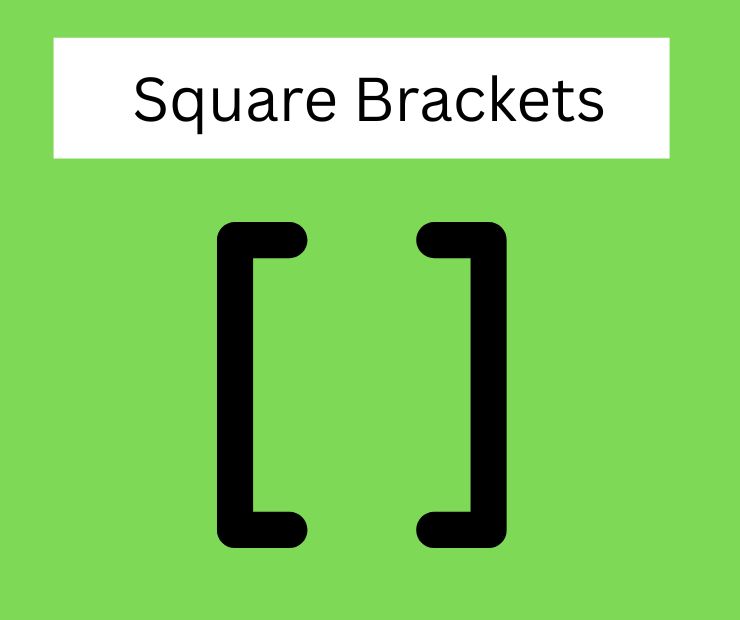
Have you ever stumbled upon a text and wondered why some words were nestled in square brackets […]? These often-overlooked punctuation marks play a crucial role in clarifying and adding context to your writing. Understanding when and how to use square brackets can elevate your communication skills, ensuring your meaning is crystal clear. In this article, we’ll explore the essential functions of square brackets, complete with practical examples to enhance your writing.
What Are Square Brackets Used For?
Square brackets serve a multifaceted role in writing, stretching beyond mere punctuation to enhance clarity and precision. In academic writing, for instance, they are invaluable for inserting explanatory notes or clarifications within quoted material.

In programming and technical documentation, square brackets denote arrays or lists, providing visual cues that help programmers navigate complex data structures. This use underscores the versatility of square brackets, allowing them to function as both a stylistic choice in literature and a practical symbol in coding.
What is the Difference Between Square Brackets and Parentheses?
Square brackets and parentheses serve distinct purposes that can significantly alter the meaning of a text. Parentheses, typically used for additional information or clarification, create a gentle interruption in the flow of a sentence. They allow authors to insert commentary, examples, or asides without derailing the main point, inviting readers to explore supplementary thoughts at their leisure.
Square brackets are often employed for a more nuanced function, particularly in academic and textual editing contexts. They signal modifications or clarifications made by an external party, such as an editor or translator. When quoting a source, the addition of square brackets can indicate that some words have been altered for clarity or context.
Rules of Square Bracket Use
Square brackets are often misunderstood punctuation marks, yet their versatility can enhance clarity and precision in your writing. One of their primary uses is to add explanatory notes or clarifications within quoted material. This allows you to maintain the integrity of the original text while ensuring that your readers grasp the necessary context.
Square brackets are vital in academic writing, especially when modifying a quote for grammatical accuracy or relevance. They signal to the reader that the alterations come from the writer, preserving the original voice while making it accessible. This transparency is key in scholarly communication, highlighting an author’s responsibility in interpreting primary sources.
Read more: Excited vs exited
Rule #8
Use brackets to add a brief, clarifying explanation or definition within a quoted passage where the original context is missing.
For Example
- The witness testified, “He said he would meet me at the usual spot [referring to the 5th Street Diner] at midnight.”
- The manual states, “Ensure the flux capacitor [the primary temporal displacement unit] is engaged before exceeding 88 mph.”
Rule #9
Use brackets to alter verb tense or person (e.g., changing “I” to “he”) to smoothly integrate a quote into your own sentence structure.
For Example
- Original Quote: “I am deeply honored to accept this award.”
- Integrated: She stated that she “[was] deeply honored to accept [the] award.”
- Original Quote: “Our findings are conclusive.”
- Integrated: The researchers announced that “[their] findings [were] conclusive.”
Rule #10
Use brackets to note the addition of italics, bold, or underlining to quoted text when you are adding the emphasis, not the original author.
For Example
- The contract’s fine print warned that “the company is not [bold added] responsible for delays caused by natural disasters.”
- The reviewer argued that the film was “a visually stunning but emotionally hollow [italics added] spectacle.”
Rule #11
Use brackets to create a smooth transition when omitting words from within a single sentence of a quote. (For omissions between sentences, use an ellipsis).
For Example
- Original Quote: “The protocol, which we developed over three years of intense testing, must be followed exactly.”
- Edited: “The protocol [ . . . ] must be followed exactly.”
- He claimed the decision was “unexpected [ . . . ] and deeply disappointing.”
Rule #12
Use brackets to insert a date, citation, or cross-reference into a quoted passage for the reader’s benefit.
For Example
- In his diary, he wrote, “Saw the finished painting [Guernica, 1937] today. It is overwhelming.”
- The statute notes, “The agency shall review the permit every five years [see § 12.05.030 for review criteria].”
Rule #13
Use brackets to indicate laughter, pauses, or nonverbal cues in a transcribed quote, especially from an interview or speech.
For Example
- The comedian joked, “My parenting style is best described as ‘enthusiastically mediocre’ [audience laughter]. No, really, my kids are proof.”
- Reflecting on the moment, she said, “It was just… [long pause] it was the quietest I have ever heard the room.”
Rule #14
Use brackets to mark the end of a page or line break when quoting from a poem or a specific edition of a text.
For Example
- In the poem, he writes of “a whisper in the pines / a secret that the moon confines” [/].
- The historical account describes the battle as “a chaos of smoke and sound [p. 157] that lasted through the night.”
When to Use Brackets for References:
Brackets are essential in referencing as they serve various purposes, enhancing both clarity and ease of understanding. One critical scenario is when you’re incorporating a quote that requires clarification or context. For instance, integrating a quote from a historical figure may necessitate the addition of context to ensure modern readers grasp the intent.
Here are five examples of when to use brackets for references:
1. Citing a Source or Page Number
-
The treaty states the border shall lie “along the thalweg of the river [see map, p. 47].”
2. Clarifying an Acronym or Abbreviation
-
The report concluded that “the initial findings from the EPA [Environmental Protection Agency] were inconclusive.”
3. Referencing a Related Figure or Table
-
The text notes “a sharp decline in yield after the third cycle [refer to Figure 3].”
4. Cross-Referencing Another Legal Section
-
The statute authorizes action “in cases of imminent hazard [as defined in § 12-A].”
5. Directing to an Appendix or Supplement
-
The methodology specifies using “the modified protocol [detailed in Appendix B].”
Square Bracket Examples in Writing
During the keynote, the CEO’s directive was brief: “Our priority is to streamline [the new onboarding process] by the end of Q3.”
The biography notes that the artist’s early years were spent “wandering the coastlines of [what is now] Northern California.”
A critic quipped that the film’s second act was “a beautifully shot, yet emotionally inert [snooze fest] of a road trip.”
Conclusion
Square brackets are invaluable tools for writers, providing clarity and context in various types of writing. By understanding their applications — such as adding clarity, indicating alterations, and ensuring proper attribution — authors can enhance the readability of their work. The examples presented highlight the importance of using brackets appropriately to maintain the integrity of quotes and cited materials. Remember, using square brackets not only helps to convey the intended message but also respects the original context of the source. So the next time you’re editing or quoting, consider how square brackets can improve your writing.