From galaxies spinning in space to the gratitude we feel in quiet moments, nouns beginning with G shape how we describe our world. Whether you’re a student building vocabulary, a writer seeking variety, or simply curious about language, understanding G nouns opens doors to clearer, more expressive communication.
Nouns—those essential parts of speech representing people, places, things, and ideas—form the foundation of every sentence we construct. In this comprehensive guide, you’ll discover over 100 nouns starting with G, organized by type and usage, complete with definitions, example sentences, and practical writing tips.
We’ve updated this 2026 edition to include modern tech terms and current language trends, ensuring you have the most relevant resources for vocabulary expansion and grammar mastery.
What Are Nouns? Quick Refresher
Nouns are words that name people, places, things, or ideas. They serve as the subject of sentence constructions or function as direct objects that receive action. In the sentence “The gardener planted grapes,” both “gardener” and “grapes” are nouns—one acts while the other receives it.
Nouns starting with G are particularly common in English, appearing frequently in everyday conversation and formal writing. Understanding noun classification helps you recognize how these words function in different contexts, making your language skills sharper and your writing more precise.
Types of Nouns Starting With G
A. Common Nouns
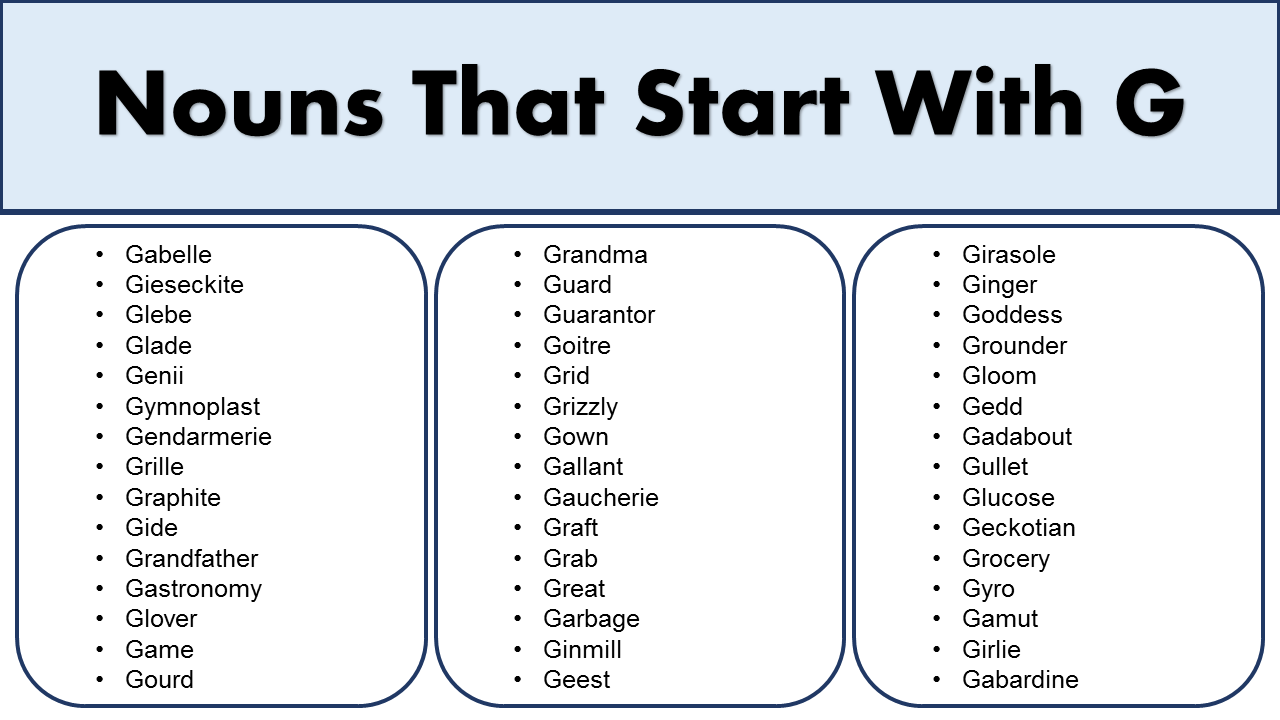
Common nouns are general names for people, places, things, or ideas—not specific individuals or locations. These everyday words form the backbone of our vocabulary and appear constantly in both speech and text.
Examples: garden, game, guitar, glass, goal, gift, garage, gate, group, girl, gold, garbage, gasoline, glacier, globe, glove, government, grade, grain, grandparent, grass, grocery, guarantee, guard, guide, guilt, guitar, gulf, gust
Example sentences:
- The children played a game in the garden behind their house.
- She carefully placed the glass of water on the granite countertop.
- Our group met at the garage to organize the gardening tools.
B. Proper Nouns
Proper nouns identify specific, unique people, places, organizations, or brands. These nouns always begin with capital letters and represent one-of-a-kind entities rather than general categories.
Examples: Germany, Google, Grand Canyon, Genesis, Georgia, Guatemala, Gandhi, Greenland, Greenwich, Gabriel, Galaxy (Samsung), Gatsby, Geneva, Goldman Sachs, Grammy Awards
Example sentences:
- We visited the Grand Canyon during our trip through Georgia last summer.
- Google headquarters in California attracts thousands of visitors annually.
- Gandhi’s philosophy influenced civil rights movements worldwide.
C. Abstract Nouns
Abstract nouns represent ideas, qualities, emotions, or concepts that cannot be physically touched or seen. These descriptive nouns add depth and emotional resonance to language, helping us express complex human experiences.
Examples: gratitude, grace, generosity, glory, gladness, growth, genius, grief, goodness, guilt, greed, gravity, grandeur, glamour, grit, guidance, guarantee, guardianship
Example sentences:
- Her generosity toward strangers demonstrated remarkable grace under pressure.
- The team’s growth over the season filled everyone with gladness and glory.
- Finding gratitude in difficult moments requires both grit and guidance.
D. Collective Nouns
Collective nouns refer to groups of people, animals, or things considered as a single unit. These noun types help us describe multiple entities efficiently.
Examples: group, gang, galaxy, gaggle (of geese), garrison (of troops), generation, guild, gallery (of artists)
Example sentences:
- A gaggle of geese crossed the road, stopping traffic completely.
- The entire generation gathered to celebrate their grandparents’ anniversary.
Comprehensive List: 100+ Nouns Starting With G
Everyday/Common G Nouns
| Word | Definition | Example Sentence |
|---|---|---|
| Garden | Cultivated area for growing plants | The vegetable garden produced tomatoes all summer. |
| Game | Form of play or competitive activity | We enjoyed a board game during the rainy afternoon. |
| Garage | Building for storing vehicles | He organized tools in the garage every weekend. |
| Gate | Movable barrier in a fence or wall | The metal gate squeaked when visitors arrived. |
| Gift | Something given voluntarily without payment | Her thoughtful gift brought tears of joy. |
| Girl | Female child or young woman | The girl excelled in mathematics and science. |
| Glass | Transparent material or drinking container | Please fill my glass with cold water. |
| Glove | Hand covering for warmth or protection | He wore a leather glove while working outside. |
| Gold | Precious yellow metallic element | The antique ring contained pure gold. |
| Grass | Green plant covering lawns and fields | Fresh grass grew quickly after spring rain. |
| Group | Collection of people or things together | Our study group meets every Tuesday evening. |
| Guitar | Stringed musical instrument | She learned to play guitar in just six months. |
| Guide | Person who shows the way or provides direction | The museum guide explained ancient Egyptian artifacts. |
| Guest | Invited visitor to a place or event | Each guest received a welcome packet. |
| Gym | Facility for physical exercise | The gym opens at five every morning. |
| Garbage | Waste materials; trash | Remember to take out the garbage tonight. |
| Gear | Equipment or mechanism for specific purpose | Camping gear filled the entire storage closet. |
| Genius | Exceptional intellectual or creative ability | Mozart demonstrated musical genius from childhood. |
| Giant | Being of extraordinarily large size | The ancient giant sequoia trees inspire awe. |
| Globe | Spherical representation of Earth | The antique globe showed colonial-era geography. |
| Goal | Desired aim or achievement | Setting clear goals improves productivity significantly. |
| Goose | Large waterbird with long neck | The Canada goose nested near the pond. |
| Government | System or group directing a political unit | The federal government announced new education policies. |
| Gown | Long, elegant dress or robe | She wore a stunning velvet gown to the gala. |
| Grade | Level of quality, rank, or school year | Students received their final grades yesterday. |
Positive G Nouns
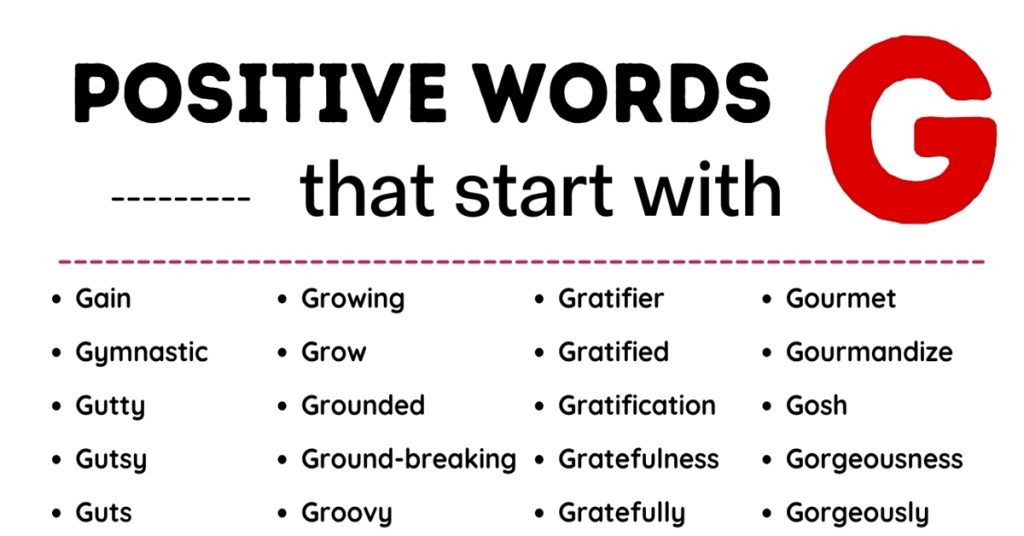
Incorporating positive nouns into your vocabulary enhances communication and creates uplifting content. These words carry optimistic connotations that strengthen writing skills across personal and professional contexts.
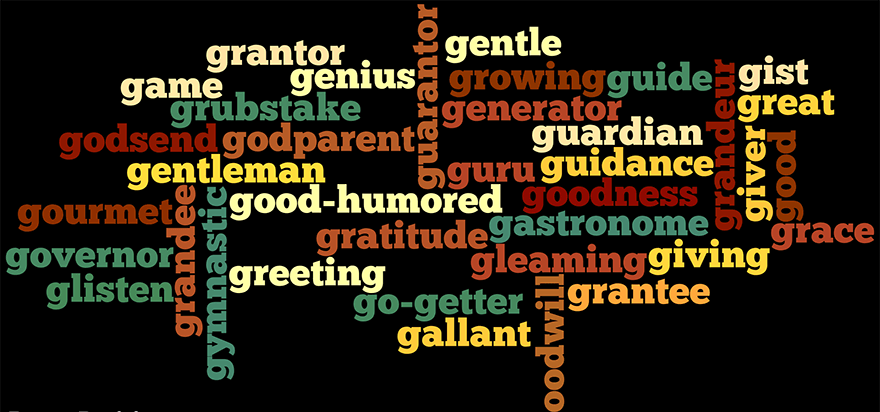
Examples: Gratitude, grace, generosity, glee, glamour, glory, goodness, guardian, giver, gentleness, gaiety, gift, gain, gladness, grandeur, greatness, gusto, goodwill, gleam
These descriptive nouns add emotional depth to language learning and help writers convey appreciation, joy, and noble qualities effectively.
Nature & Animals
Examples: Goat, giraffe, gorilla, gecko, goose, gazelle, garden, grove, glacier, grassland, gulf, geyser, gorge, gravel, greenery
The natural world provides abundant G nouns for vocabulary expansion, from animals roaming grasslands to geological formations shaping landscapes.
Food & Cooking
Examples: Garlic, ginger, grape, gravy, graham cracker, gumbo, gelato, grapefruit, granola, guacamole
Culinary nouns starting with G appear frequently in recipes and food writing, making them essential for anyone interested in cooking or nutrition.
Professional & Academic
Examples: Governor, geologist, geneticist, graduate, guidance counselor, gynecologist, geographer, glazier, goldsmith, grammarian
These professional titles and academic roles demonstrate how G nouns classify people by their expertise and occupations.
Modern/Tech Terms (2026 Update)
Examples: Gigabyte, gamer, gadget, GPS, gateway, grid (power/data), GUI (graphical user interface), GIF, gig economy, graphics card
Technology continues evolving, introducing new G nouns into everyday language. Understanding these terms supports digital literacy and modern communication.
G Nouns By Length
Understanding word length helps create varied, engaging writing with better rhythm and flow.
Short G nouns (3-4 letters): Gap, gas, gel, gem, guy, gun, gym, gum, gut, god, gig, gal, gag, god
These compact words deliver quick, punchy impact in sentences and work well for concise communication.
Medium G nouns (5-7 letters): Garden, guitar, garage, galaxy, gender, gospel, gravity, gallery, gesture, glacier, glimpse, goodness
Medium-length nouns provide balance and are most common in everyday speech and writing.
Long G nouns (8+ letters): Generation, government, grasshopper, grandmother, graduation, guarantee, gymnasium, geographer, generosity, globalization
Longer nouns often carry more specific meanings and add sophistication to formal writing. Varying word length throughout your text creates natural rhythm and prevents monotony, essential elements of effective grammar basics and composition.
Tips for Using G Nouns Effectively
1. Vary your vocabulary – Avoid repeating the same G nouns throughout your text. Instead of writing “garden” five times, alternate with “plot,” “yard,” or “green space” when appropriate.
2. Match tone to context – Choose formal nouns like “guardian” or “governance” for professional writing, while casual terms like “guy” or “gadget” suit informal conversation.
3. Use specific nouns over generic ones – Replace vague words with precise alternatives. Instead of “thing,” specify whether you mean “gadget,” “gem,” or “garment.”
4. Pair with strong adjectives – Enhance G nouns with descriptive modifiers: “gleaming gold,” “gracious gift,” “towering giant,” or “magnificent glacier.”
5. Consider plural forms carefully – Some G nouns change meaning in plural (glass/glasses, good/goods). Understanding these transformations strengthens noun classification skills.
Common mistakes to avoid:
- Don’t capitalize common nouns unless starting sentences
- Avoid overusing abstract nouns; balance with concrete examples
- Check subject-verb agreement with collective nouns (the group is/are)
- Ensure proper nouns reference actual specific entities
Practical writing tip: Read your work aloud to identify repetitive noun usage. Your ear catches patterns your eyes miss, helping you spot opportunities for vocabulary expansion.
Special Categories
Silent G Words
English contains several G nouns where the initial letter remains silent in pronunciation, creating potential spelling challenges.
Examples: Gnome (decorative garden figure), gnat (small flying insect), gnu (African antelope)
Pronunciation guide: In these words, skip the G sound entirely and begin with the N sound—”nome,” “nat,” “new.”
G Nouns in Idioms
Common expressions incorporate G nouns in ways that extend beyond literal meanings:
- “Get the ball rolling” – Begin a process or activity
- “Grain of salt” – Skeptical consideration of information
- “Green thumb” – Natural talent for growing plants
- “Grease the wheels” – Facilitate smooth operation
- “Glass ceiling” – Invisible barrier to advancement
- “Golden opportunity” – Exceptionally favorable chance
Understanding these idioms enhances language learning by revealing how nouns function in figurative speech, adding depth to your communication skills.
Practice Exercises
Fill-in-the-Blank Sentences
Test your understanding by completing these sentences with appropriate G nouns:
- The _______ bloomed beautifully after weeks of careful watering.
- She demonstrated _______ by sharing her lunch with newcomers.
- Ancient _______ carved these mysterious symbols into stone.
- Our _______ for this quarter is increasing customer satisfaction.
- The _______ led tourists through the historic district.
Categorization Quiz
Match each noun to its correct type (Common, Proper, Abstract, or Collective):
- Galaxy (Samsung) – ?
- Gratitude – ?
- Garage – ?
- Gang – ?
- Guatemala – ?
Creative Writing Prompt
Write a short paragraph (50-75 words) incorporating at least eight different G nouns. Challenge yourself to include various types—common, abstract, and proper nouns—while maintaining natural flow.
These exercises reinforce grammar basics and help solidify understanding of noun definitions through active practice rather than passive reading.
Frequently Asked Questions
What are the most common nouns starting with G?
The most frequently used G nouns include game, girl, group, government, ground, guy, god, glass, goal, and garden. These appear regularly in everyday conversation and writing.
What are some positive nouns that start with G?
Positive G nouns include gratitude, grace, generosity, glee, gift, gladness, glory, goodness, guardian, and gentleness—all conveying uplifting qualities and emotions.
How many nouns start with the letter G in English?
English contains several thousand G nouns when counting all forms, though most speakers regularly use about 200–300 in daily communication and writing.
What are some G nouns for kids to learn?
Child-friendly G nouns include game, gift, goat, garden, gate, giraffe, glove, grapes, grass, and guitar—concrete words children commonly see and use.
What’s the difference between common and proper G nouns?
Common G nouns (e.g., garden, guitar) name general categories, while proper nouns (e.g., Germany, Google) identify specific, unique entities and always require capitalization.
Are there any G nouns with unusual plural forms?
Yes—goose → geese is a classic example, and some abstract nouns like goodness rarely take plural forms, showing irregular patterns in English grammar.
Conclusion
Mastering nouns starting with G enriches your vocabulary and strengthens communication across all contexts. From everyday words like garden and game to abstract concepts like gratitude and grace, these essential parts of speech help you express ideas with precision and variety.
Practice incorporating diverse G nouns into your writing, experiment with different types and categories, and watch your language skills flourish. Bookmark this guide for future reference, share it with fellow language learners, and explore our complete collection of noun lists to build comprehensive vocabulary.
Your journey toward linguistic excellence continues with every new word you confidently add to your expressive arsenal.
Additional Resources
Expand your language learning beyond G nouns with these helpful resources:
- Other Noun Lists: Explore comprehensive guides for nouns starting with A, B, C, D, E, F, and all remaining letters to build complete vocabulary mastery.
- Grammar Guides: Deepen understanding of noun classification, parts of speech, and sentence construction through structured grammar basics tutorials.
- Vocabulary Building Tools: Utilize flashcard apps, word-of-the-day services, and interactive quizzes designed specifically for vocabulary expansion and retention.
- Recommended Reading: “The Elements of Style” strengthens overall writing skills, while “Word Power Made Easy” accelerates systematic vocabulary development through proven techniques.
These resources support continued growth in language learning, helping you master not just G nouns but the entire landscape of English grammar and descriptive nouns across all categories.